
Foreword
Foreword
~*~
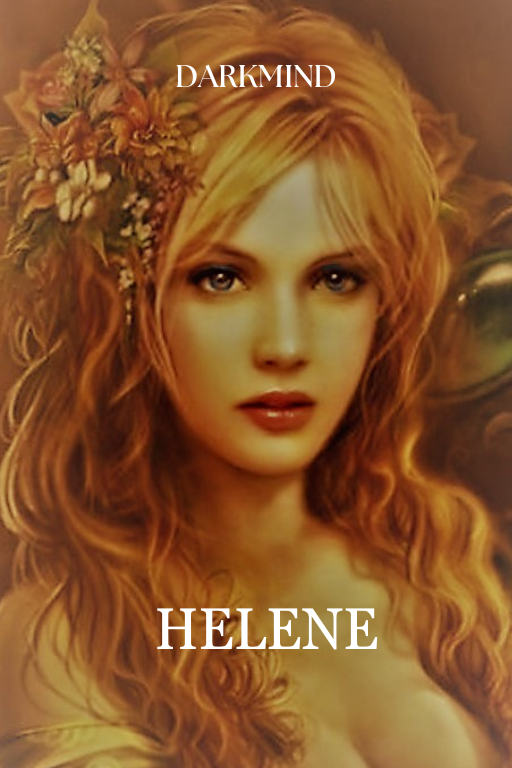
“This woman is too much like the immortal Goddesses,” says Homer in the Iliad. Helen, daughter of Leda and Zeus, was “the most beautiful of women”. She was so beautiful that she aroused the jealousy of Aphrodite, Goddess of Love. Wife of Menelaus, King of Sparta, she was kidnapped by Paris, the Trojan prince. It was for her sake, then, that the Trojan War had pitted Danaeans and Achaeans against each other for so many years, right up to Odysseus’ famous horse trick, which saw the downfall of King Priam’s proud city.
“This is all your fault. It was the Gods who sent you to me to bring about my downfall,” Priam told her as he was watching from his palace as his city went up in flames.
A black feather suddenly landed beside the King, which he immediately saw as a bad omen. Thanatos – death personified – was approaching, and there was nothing he could do to escape his fate.
After the fall of Troy, legend has it that Helen returned to her lawful husband, Menelaus, and that they both sailed to Greece where they had many adventures. Since Plato, philosophers have seen in this woman more than just a mythological character, but also a symbol of the soul’s wanderings in search of the absolute. They couldn’t have said it better. Indeed, some mysterious scrolls found in an amphora off the island of Leucippé tell a very different story of Helen’s fate.
In fact, it was discovered that, while an unfortunate fate was befalling the city that had welcomed her, Helen was sifting through thousands of slaves, looking for one with an appearance similar to her own. Among the hundreds of servile females presented to her, she finally settled on a beautiful, sun-kissed Veneta. She then spent weeks educating and training her while Trojan soldiers were fighting at the city gates.
And one day, when the Achaeans successfully invaded Troy, this unknown slave was the one Menelaus seized after slitting Prince Deiphobe’s throat, the one he brought back to Sparta, and the one who shared long years of her life with him in their palace, surrounded by the fabulous treasures brought back from the devastating and bloody war that had lasted ten years.
And what about Helen? Faced with the terrible disaster her beauty had caused, she decided to end her life. Escaping from Troy via an ancient underground passage, she emerged into the open air far from the valiant city, which was already in flames and whose inhabitants’ cries of agony, despair, and panic were echoing on the horizon. Unwilling to listen to the atrocious sounds of men having their throats slit and women being raped, the young woman set off without a glance behind her, running towards the top of a high cliff, hoping to atone for her sins by throwing herself into the void.
Unfortunately, events did not turn out as she had planned. Indeed, Helen’s beauty not only attracted the attention of mortals, but also that of the Gods – specifically Poseidon who couldn’t help but lust after his brother’s daughter. As a result, when the young woman’s body ripped through the raging waves of the sea now known as the Aegean, the God of the oceans didn’t hesitate for a second to seize her before dropping her off on a distant beach.
Stripped of all her queenly finery, Poseidon left her completely naked as on the first day, revealing only a thin chain around her neck made of vulgar metal and bearing a medal engraved with a single word: eta. But before leaving, the God of the oceans did one last thing to the young woman, something that could be considered an indirect attack on his brother, Zeus. He erased from Helen’s mind all memory of who she was, what she had experienced, and whom she had loved.
“She will have to learn and undergo many trials before a new Helen can be born,” he said before setting off for his kingdom.
Thus began the new destiny of the woman whose beauty had provoked the deadliest of all wars.
Rate This Chapter
We hope you enjoyed this chapter!
Your feedback is important. Please take a moment to rate this chapter and share your thoughts.
Chapters
Comments
French
- Free Avant-propos May 20, 2025 3
- Free Chapitre 01 - Naissance May 20, 2025 0
- Free Chapitre 02 - L’esclave du pêcheur (1) May 20, 2025 0
- Free Chapitre 03 - L’esclave du pêcheur (2) May 20, 2025 0
- Free Chapitre 04 - La "pornaï" du port (1) June 1, 2025 1
English
- Free Foreword May 20, 2025 0
- Free Chapter 01 - Birth May 20, 2025 0
- Free Chapter 02 - The fisherman’s slave (1) May 20, 2025 1
- Free Chapter 03 - The fisherman’s slave (2) May 20, 2025 1
- Free Chapter 04 - The "pornaï" of the port (1) June 4, 2025 0
Comments for chapter "Foreword"
MANGA DISCUSSION