
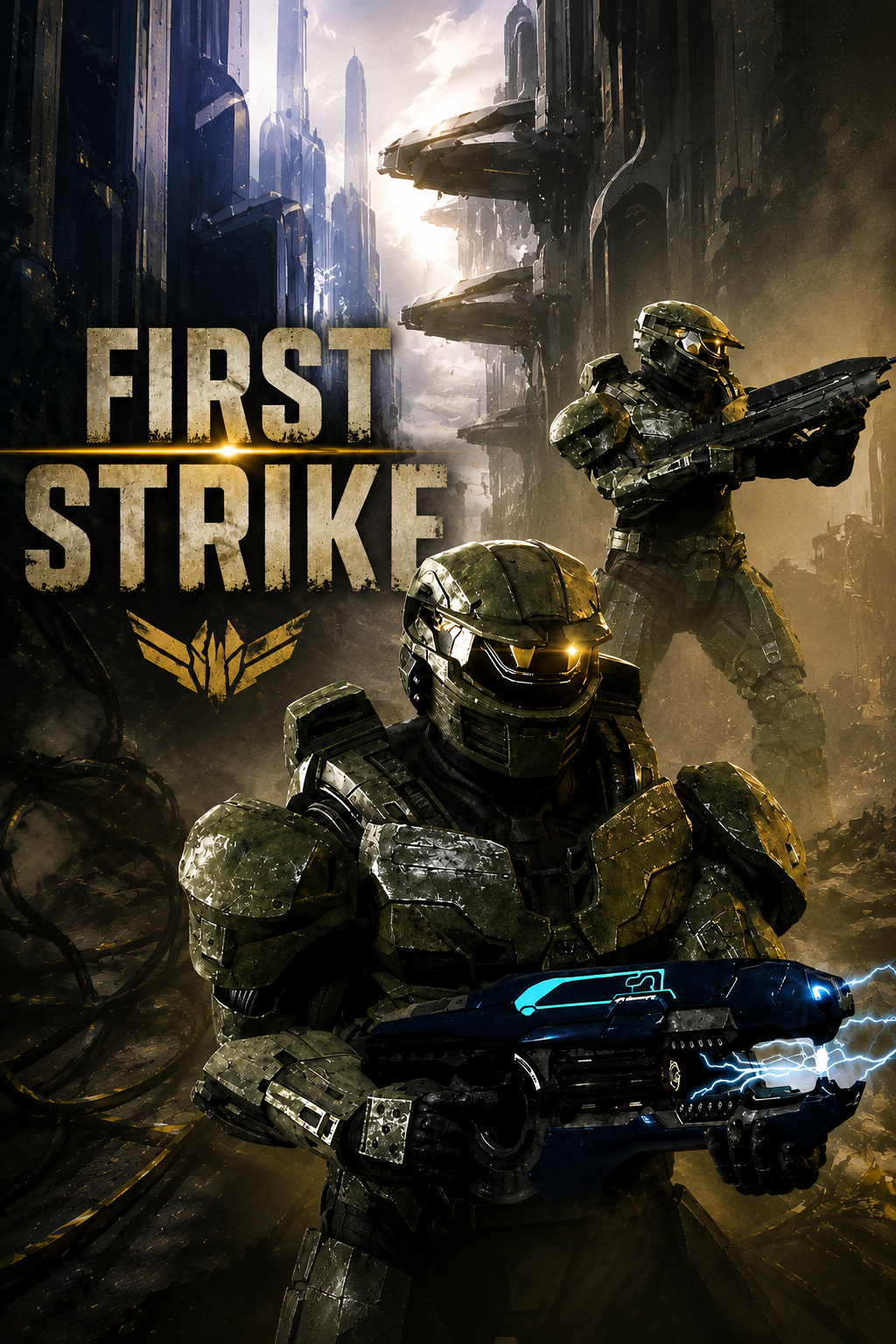
Section 1 – THRESHOLD
1637 Hours, September 22, 2552 (Military Calendar)
Aboard Longsword Fighter, Soell System,
Halo Debris Field. Three Weeks Later.
The Master Chief settled into the pilot’s seat of the Longsword attack craft. He didn’t fit. The contoured seat had been engineered to mate with a standard-issue Navy flight suit, not the bulky MJOLNIR armor.
He scratched his scalp and breathed deeply. The air tasted odd—it lacked the metallic quality of his suit’s air scrubbers. This was the first quiet moment he’d had to sit, think, and remember. First there was the satisfaction after the successful space op at Reach, which went sour after Linda was killed and the Covenant glassed the planet… and Red Team. Then the time spent in a Pillar of Autumn cryotube, the flight from Reach, and the discovery of Halo.
And the Flood.
He stared out from the front viewport and fought down his revulsion at the memory of the Flood outbreak. Whoever had constructed Halo had used it to contain the sentient, virulent xenoform that had nearly claimed them all. The rapidly healing wound in his neck, inflicted by a Flood Infection Form during the final battle on Halo’s surface, still throbbed.
He wanted to forget it all… especially the Flood. Everything inside him ached.
The system’s moon, Basis, was a silver-gray disk against the darkness of space, and beyond it was the muted purple of the gas giant Threshold. Between them lay a glistening expanse of debris—metal, stone, ice, and everything else that had once been Halo.
“Scan it again,” the Master Chief told Cortana.
“Already completed,” her disembodied voice replied. “There’s nothing out there. I told you: just dust and echoes.”
The Master Chief’s hand curled into a fist, and for a moment he felt the urge to slam it into something. He relaxed, surprised at his frayed temper. He’d been exhausted in the past—and without a doubt the fight on Halo had been the most harrowing of his career—but he’d never been prone to such outbursts.
The struggle against the Flood must have gotten to him, more than he’d realized.
With effort he banished the Flood from his mind. Either there’d be time to deal with it later… or there wouldn’t. Worrying about it now served no useful purpose.
“Scan the field again,” he repeated.
Cortana’s tiny holographic figure appeared on the projection pad mounted between the pilot’s and system-ops seats. She crossed her arms over her chest, visibly irritated with the Master Chief’s request.
“If you don’t find something out there we can use,” he told her, “we’re dead. This ship has no Slipspace drive, and no cryo. There’s no way to get back and report. Power, fuel, air, food, water—we only have enough for a few hours.
“So,” he concluded as patiently as he could manage. “Scan. Again.”
Cortana sighed explosively, and her hologram dissolved. The scanner panel activated, however, and mathematical symbols crowded the screen.
A moment later the scanner panel dimmed and Cortana said, “There’s still nothing, Chief. All I’m picking up is a strong echo from the moon… but there are no transponder signals, and no distress calls.”
“You’re not doing an active scan?”
Her tiny hologram appeared again, and this time static flashed across her figure. “There are trillions of objects out there. If you want I can start to scan and identify each individual piece. If we sit here and do nothing else, that would take eighteen days.”
“What if someone’s out there but they turned off their transponder? What if they don’t want to be found?”
“That’s highly un—” Cortana froze for a split second. The static around her vanished, and she stared off into space. “Interesting.”
“What?”
Cortana looked distracted, then seemed to snap out of it. “New data. That signal echo’s getting stronger.”
“Meaning?”
“Meaning,” she replied, “it’s not an echo.”
The scanner panel hummed back to life as Cortana activated the Longsword’s long-range detection gear. “Uh-oh,” she said, a moment later.
The Chief peered at the scan panel as Cortana identified the contact. The distinctive, bulbous silhouette of a Covenant cruiser edged into view as it moved around the moon’s far side.
“Power down,” he snapped. “Kill everything except passive scanners and minimal power to keep you online.”
The Longsword darkened; Cortana’s hologram flickered and faded as she killed power flow to the holosystem.
The cruiser moved into the debris field, prowling like a hungry shark. Another cruiser appeared, then another, and then three more.
“Status?” he whispered, his hands hovering over the weapons controls. “Have they spotted us?”
“They’re using the same scanning frequencies as our system,” Cortana said in his helmet speaker. “How strange. No mention of this phenomenon in any of the UNSC or ONI files on the Covenant. Why do you suppose they’d use the same frequencies?”
“Never mind that,” the Chief said. “They’re here and looking for something. Like I said before, if there are survivors out there, they’d be powered down.”
“I can listen to their echoes,” Cortana said, her voice flat and oddly procedural. Operating at lower power levels seemed to limit her more colorful behavior. “Process active: analyzing Covenant signals. Piggybacking their scans. Diverting more runtime to the task. I’m building a multiplex filtering algorithm. Customizing the current shape-signature recognition software.”
Another ship rounded the horizon of Basis. It was larger than any Covenant ship the Master Chief had seen. It had the sleek three-pronged shape of one of their destroyers, but it must have been three kilometers long. Seven plasma turrets were mounted on universal joints—enough firepower to gut any ship in the UNSC fleet.
“Picking up encrypted transmissions from new contact,” Cortana whispered. “Descrambling… lots of chatter… orders being given to the cruisers. It appears to be directing the Covenant fleet operations in the system.”
“A flagship,” the Chief murmured. “Interesting.”
“Scan still in progress, Chief. Stand by.”
John got out of the sys-ops seat. He had no intention of just “standing by” with seven Covenant warships in the system.
He drifted to the aft compartment of the Longsword fighter. He’d assess what equipment was on board. He might get lucky and find a few of those Shiva nuclear-tipped missiles.
As he had seen when he first boarded the ship, the cryotube had been removed. He wasn’t sure why, but maybe, like everything else on the Pillar of Autumn, the ship had been stripped down and upgraded for their original high-risk mission.
Where the cryo unit was supposed to be there was a new control panel. The Chief examined it and discovered it was a Moray space-mine laying system. He didn’t power it on. The Moray system could dispense up to three dozen free-floating mines. The mines had tiny chemical-fuel drives that allowed them to keep a fixed position or move to track specific targets. These would come in handy.
He moved to the weapons locker and forced it open—it was empty.
The Chief checked his own assault rifle: fully functional, but only thirteen rounds remained in the magazine.
“Got something,” Cortana said.
He returned to the sys-ops seat. “Show me.”
On the smallest viewscreen, a silhouette appeared: a small, bullet-shaped cone with maneuvering thrusters on one end.
“It could be a cryotube,” Cortana said. “Thruster and power packs can be affixed on their aft sections for emergencies… if a ship has to be abandoned, for example.”
“And most of the crew on the Pillar of Autumn never had a chance to be revived from cryo,” the Chief said. “They could have been jettisoned before the ship went down. Move us toward them. Docking thrusters only.”
“Course plotted,” Cortana said. “Thrusters engaged.”
There was a slight acceleration.
“ETA twenty minutes, Chief. But given the Covenant cruisers’ current search pattern, I estimate they will encounter the pod in five minutes.”
“We need to move faster,” the Chief told her, “but without firing the engines. The drive emissions will show up like a flare on their sensors.”
“Hang on,” Cortana said. “I’ll get us there.”
The Chief donned his helmet and locked its atmosphere seals. Status lights pulsed green. “Ready,” he said.
The aft hatch of the Longsword breached and slammed open. There was an explosive sound as the atmosphere vented. The Longsword jumped forward; the Chief’s head slammed into the back of his helmet.
“Adjusting course,” Cortana said calmly. “ETA two minutes.”
“How are we going to stop?” he asked.
She sighed. “Do I have to think of everything?” The aft hatch resealed, and John heard the faint hiss as the internal compartments pressurized.
One of the sleek Covenant cruisers slowed and turned toward them.
“Picking up increased scanning signal activity and strength,” Cortana reported.
The Chief’s hand hovered over the weapons system console. It would take several seconds for the weapons to power up. The 110mm rotary cannons could fire immediately, but the missiles would have to wait for their target-lock software to initialize. By then the cruiser, which outgunned them a hundred to one, would turn the Longsword into molten slag.
“Attempting to jam their scanners,” Cortana said. “That may buy us some time.”
The Covenant cruiser turned away, slowed, and turned back to face the comparatively tiny Longsword. It took no further action… as if it were waiting for them to get closer.
So far so good. The Chief clenched and unclenched his gauntleted hand. We’re not dead yet.
He glanced at the scan display. The contact resolved into a clearer image: definitely a UNSC cryopod. It tumbled, and he saw that what he thought was a single pod was in fact three of them, affixed side by side.
Three possible survivors out of the Pillar of Autumn’s total complement of hundreds. He wished there were more. He wished Captain Keyes were here. In the Chief’s opinion Keyes had been the most brilliant spatial tactician he had ever encountered… but even the Captain would have thought twice about approaching seven Covenant warships in a single Longsword.
He risked feeding more ship’s power to Cortana’s systems. If they were going to make it through this, he needed her as effective as possible.
“New contact,” Cortana said, interrupting his thoughts. “I think it is, anyway. Whatever it is, it’s stuck onto a chunk of rock, half a kilometer in diameter. Damn, it just rotated out of my view.”
On the display Cortana replayed a partial silhouette of an oddly angled shape on the surface of the rock. She highlighted its contours, rotated the polygon, and overlaid this onto a schematic of a Pelican dropship.
“Match with a tolerance of fifty-eight percent,” she said. “They might have parked there to avoid detection, as you suggested.”
The Chief thought he detected a hint of irritation in her voice, as if she resented him for thinking of something she had not.
“Or,” Cortana continued, “more likely, the craft merely crashed there.”
“I don’t think so.” He pointed at the display. “The position of that wing indicates it’s nose-out—ready for takeoff. If it had crash-landed, it would be faced the other way.”
Another Covenant cruiser moved toward this new ship.
“Coming about, Chief,” Cortana told him. “Brace yourself, and then get ready to retrieve the pods.”
The Chief unsnapped his harness and drifted aft. He grabbed a tether and clipped one end to his suit, the other to the bulkhead of the Longsword.
He felt the maneuvering thrusters fire, and the ship rotated 180 degrees.
“Decompression in three seconds,” Cortana said.
The Chief opened the empty weapons locker and climbed partially inside. He braced himself.
Cortana dropped the aft hatch, and the inside of the ship exploded out; the Chief slammed into the door of the locker, denting the centimeter-thick Titanium-A.
He climbed out and Cortana overlaid a blue arrow-shaped NAV point on his heads-up display, indicating the location of the drifting cryopods.
The Chief jumped out of the Longsword.
He floated through space. He was only thirty meters from the pods, but if he’d guessed wrong about his trajectory and missed the target, he wouldn’t get a second chance. By the time he reeled himself back to the Longsword and tried again, those Covenant ships were certain to kill them all.
He stretched his arms and hands toward the cylinders. Twenty meters to go.
His approach was off. He shifted his left knee closer to his chest and started a slow tumble.
Ten meters.
His upper body rotated “down” relative to the pods. If he spun just right as he passed the cryotubes, it would give him enough extra reach to make contact. He hoped.
He rotated back… almost standing “up” now.
Three meters.
He stretched his arms until the elbow joints creaked and popped; he stretched his hands, willed his fingers to elongate.
His fingertips brushed against the smooth surface of the leading cryopod. It slid off and over and touched the second pod. He flexed and failed to grab hold. He scratched the surface of the third and final pod—his middle finger hooked on the frame.
His body swung inward, curled, and landed on the pod. He quickly looped his tether through the frame, secured himself to it, and pulled their combined mass back to the Longsword.
“Hurry, Chief,” Cortana said over the COM. “We’ve got trouble.”
The Chief saw exactly what the trouble was: The engines of two Covenant cruisers flared electric blue as they accelerated toward the Longsword. The plasma and laser weapons along their hulls warmed from red to orange as they readied to fire.
He pulled as fast as he could, making minor adjustments with the muscles in his braced legs so his motions didn’t send them into a tumble in the zero gravity.
The Longsword was a sitting duck for those Covenant cruisers. Cortana couldn’t fire the engines until he got on board. Even if he and the pods survived the thruster wash, any evasive maneuver Cortana made would snap him and his cargo like the end of a whip.
The Covenant ships were within firing range, lined up perfectly to destroy the Longsword.
Three missiles streaked though space, impacting on the starboard side of the lead Covenant ship. The explosion splashed harmlessly across its shield, which shimmered silver as it dissipated the energy.
The Chief turned his head and saw the Pelican blast off from the asteroid where it had been hiding. It rocketed on a perpendicular course toward the two Covenant ships.
The cruisers came about, apparently more interested in hunting live prey than the motionless Longsword.
The Chief gave one final yank on the tether. He and the pods flew through the aft hatch and crashed into the deck of the Longsword.
Cortana immediately sealed the hatch and fired the engines.
The Chief climbed into the system-ops seat just as they accelerated and turned toward the cruisers. He activated the weapons systems.
The two Covenant cruisers powered their engines and pursued the Pelican, but it had entered a dense region of the debris field, dodged a chunk of metal and rock, dived over an iceball, and charged through clouds of shattered alien metal. The Covenant fired: Energy blasts impacted on the debris and missed the Pelican.
“Whoever’s piloting that Pelican knows their stuff,” Cortana said.
“We owe them a favor.” John fired the Longsword’s guns, and tiny silver dots punctuated the trailing Covenant cruiser’s shields. “Let’s settle that debt.”
“You realize,” Cortana said, “that we really can’t damage those Covenant ships.”
The cruiser slowed and turned toward them.
“We’ll see about that. Get me a firing solution for the missiles. I want them to target their plasma turrets just before they fire. They have to drop a section of their shields for a fraction of a second.”
“Working,” Cortana replied. “Without precise data, however, I’ll have to base my calculations on several assumptions.” A string of mathematics appeared on the weapons-ops panel. “Give me fire control.”
John punched the auto override on the firing systems. “It’s yours,” he said.
The Covenant cruiser’s plasma turrets turned to track them as the ship came to bear. They warmed, and Cortana fired all the Longsword’s ASGM-10 missiles.
White vapor trails snaked toward the target.
“Let’s move!” the Chief said.
The Longsword accelerated into the debris field, following the Pelican’s path. The aft camera displayed the missiles racing to their target. Antimissile laser fire stabbed though space, and three of the missiles exploded into red fireballs. The Covenant’s plasma turret glowed white hot—about to fire—when the last missile impacted. The explosion smeared across the hull.
At first the Chief thought it had hit the shield, but then he saw that the explosion was inside the shimmering envelope of energy. The plasma turrets fired; their energy was immediately absorbed into the cloud of dust and vapor around the ship. Dull red plasma ballooned inside the cruiser’s shield, obscuring its sensors. The ship listed to port, momentarily blind.
“That should keep them busy for a while,” Cortana said.
The Longsword arced under a half-kilometer-wide metal plate—just as a plasma bolt impacted and boiled the surface, sending the plate sputtering and spinning through space.
“Or not,” Cortana muttered. “Better let me drive.”
The autopilot engaged, and the controls jerked out of the Chief’s hand. The Longsword’s afterburners kicked in, and it accelerated toward a field of tumbling rocks. Cortana rolled and pitched, keeping the hull mere meters from the jagged surfaces.
The Chief hung on to the seat with one hand and pulled his harness tight with the other. He moved the scanner display to the center viewscreen and saw the two nearest Covenant cruisers vectored toward his and the Pelican’s position. The two UNSC ships might evade and dodge through the debris field for a few minutes, but soon their fuel would be exhausted, and the Covenant would move in for the kill.
And where could they really run to, anyway? Neither ship had Shaw-Fujikawa Translight Engines, so they were stuck in this system and the Covenant knew it. They could afford to take their time and play with their prey before they pounced.
The Chief performed a sweep scan of the system looking for something—anything to give him a tactical advantage. No, thinking of tactics was going to get him killed. There was no tactical advantage he could gain that would give him a victory in this mismatch. He had to change the rules—change his strategy.
He scanned the massive Covenant flagship—that was the key. That’s how he’d be able to turn the tables on the enemy.
He keyed the COM system and hailed the Pelican. “This is Master Chief SPARTAN-One-One-Seven. Recognition code Tango Alpha Three Four Zero. Copy.”
“Copy,” a woman’s voice answered. “Warrant Officer Polaski here.” Other voices argued in the background. “Damn good to hear you, Chief.”
“Polaski, proceed at maximum burn to this position.” He dropped a NAV point on the display directly on the Covenant flagship. He included an exit vector indicating a rough course.
There was silence over the COM.
“Copy, Polaski?”
“I copy. Plotting course now, Chief.” The voices arguing in the background became loud and more strained. “I hope you know what you’re doing. Polaski out.” The channel snapped off.
“Get us there, Cortana,” he said, tapping the NAV point. “As fast as you can make this thing fly.”
The Longsword rolled right and pitched toward the moon, Basis. The chief’s safety harness groaned as gee forces increased.
“You do know what you’re doing?” Cortana asked. “I mean, we’re headed straight toward the largest and most dangerous Covenant ship in this system. I assume this is part of some daring and brutally simplistic plan you’ve cooked up?”
“Yes,” the Chief replied.
“Oh, good. Hang on,” Cortana said. The Longsword rolled to port and dived under a rock. An explosion detonated aft of the ship. “Looks like your ‘plan’ has gotten their attention. I’m reading all six Covenant cruisers moving to overtake us at flank speed.”
“And the Pelican?”
“Still there,” Cortana reported. “Taking heavy fire. But on trajectory to the NAV point… moving slower than us, of course.”
“Adjust our speed so we arrive at the same time. When you’re in range for a secure system link, let me know.”
The Longsword decelerated; it shuddered to starboard and then to port, and laser fire flashed along either side.
“You never told me,” Cortana said in a voice that was equal parts irritation and calm indifference, “precisely what your plan is.”
“Something Captain Keyes would approve of.” The Chief summoned the navigation console on the main display. “If we survive long enough, I want a course from here”—he tapped the NAV point over the flagship—“into the gravity well of Basis to slingshot us around.”
“Done,” Cortana replied. “I still—Hey, they’ve stopped firing.”
The Chief tapped the aft camera. The six cruisers continued their pursuit, but the tips of their weapons cooled as they powered down. “I was counting on this. We’re on the same line of fire as their flagship. They won’t shoot.”
“Pelican now twelve hundred kilometers and closing. Within range for system link.”
The Chief hailed the Pelican. “Polaski, release your controls. We’re taking over.”
“Chief?”
“Establish encrypted system link. Acknowledge.”
A long pause, then, “Roger.”
Cortana’s hologram appeared on the tiny protection pad. She appeared to listen intently for a moment, and then declared, “Got them.”
“Synchronize our courses, Cortana. Put us right on top of the Pelican.”
“Maneuvering to intercept the Pelican. Five hundred kilometers to flagship.”
“Prepare to alter our course, Cortana, as we pass the flagship. Also get ready to direct all scanners at the flagship if we pass.”
“ ‘If?’ ” Cortana asked.
The flagship’s turrets turned to bear on the Longsword and Pelican. They glowed like angry eyes in the dark.
“Three hundred kilometers.”
Light sparkled along the length of the Covenant craft as it prepared to fire; dull red plasma gathered; three torpedoes extruded and raced toward them.
“Evasiv—” the Chief said.
Cortana banked hard port, starboard, and then hit the afterburners and pulled up. Streaks of hellfire brushed close to the hulls of the Longsword and Pelican—then were gone behind them.
The Chief had hoped for this: Their extreme oblique approach angle combined with their speed made them hard to hit, even for the notoriously accurate Covenant plasma weapons.
“Ten kilometers,” Cortana announced. “Scanning in burst mode.”
They flashed over the three-kilometer-long ship in the blink of an eye. The Chief saw gun turrets straining to track their approach. The alien craft had sleek lines, relatively flat top to bottom, but it curved from stem to stern into three distinct sections. Along its hull ran glowing blue conduits of superheated plasma; surrounding the ship was a faint shimmer of silver energy shields.
He eased back into his seat. The Chief hadn’t realized that he’d been holding his breath, and he exhaled. “Good,” he said. “Very good.”
“Burning into a high slingshot orbit,” Cortana announced.
The Longsword’s engines rumbled. The acceleration played hell with the Chief’s inner ear. He wasn’t certain for a moment which way was up.
“Bring us closer to the Pelican,” he said. “Right on top. Give me a hard dock on its top access hatch.”
Cortana set her hands on her hips and frowned. “Readjusting burn parameters. But you know a linked-ship configuration during an orbital burn is not stable.”
“We won’t be linked long,” he said and slipped out of his harness. He drifted aft, pulled himself down to the floor and opened the Longsword’s access hatch. Green lights on the intervening pressure door winked on in succession. He removed the safeties and popped the seal.
A hand reached up from the other side. John pulled the person through.
The shock only lasted a moment. John’s reflexes kicked in—he grabbed a handful of the man’s uniform, kicked the hatch shut, and propelled both of them against the hull. With a lightning-quick motion, he drew the newcomer’s pistol and aimed it squarely at the man’s forehead.
“You were dead,” the Chief said. “I saw you die. On Jenkins’s mission record. The Flood got you.”
The black man smiled a set of perfect white teeth. “The Flood? Hell, Chief, it’ll take more than that pack of walking alien horror-show freaks to take out Sergeant A. J. Johnson.”
Rate This Chapter
We hope you enjoyed this chapter!
Your feedback is important. Please take a moment to rate this chapter and share your thoughts.
Chapters
Comments
English
- Free Petra August 22, 2026 1
- Free Tug O’ War August 22, 2026 1
- Free ADJUNCT August 22, 2026 1
- Free Section 7 – HARBINGER - Epilogue August 22, 2026 1
- Free Chapter 36 August 22, 2026 1
- Free Chapter 35 August 22, 2026 1
- Free Chapter 34 August 22, 2026 1
- Free Chapter 33 August 22, 2026 1
- Free Chapter 32 August 22, 2026 1
- Free Section 6 – OPERATION: FIRST STRIKE - Chapter 31 August 22, 2026 8
- Free Chapter 30 August 22, 2026 2
- Free Chapter 29 August 22, 2026 8
- Free Chapter 28 August 22, 2026 1
- Free Chapter 27 August 22, 2026 1
- Free Section 5 – MASSACRE AT ERIDANUS SECUNDUS - Chapter 26 August 22, 2026 1
- Free Chapter 25 August 22, 2026 2
- Free Chapter 24 August 22, 2026 1
- Free Chapter 23 August 22, 2026 1
- Free Section 4 – GAMBIT - Chapter 22 August 22, 2026 2
- Free Chapter 21 August 22, 2026 1
- Free Chapter 20 August 21, 2026 1
- Free Chapter 19 August 21, 2026 1
- Free Chapter 18 August 21, 2026 1
- Free Chapter 17 August 21, 2026 1
- Free Section 3 – RESCUE - Chapter 16 August 21, 2026 1
- Free Chapter 15 August 21, 2026 7
- Free Chapter 14 August 21, 2026 1
- Free Chapter 13 August 21, 2026 1
- Free Section 2 – DEFENSE OF CASTLE BASE - Chapter 12 August 21, 2026 2
- Free Chapter 11 August 21, 2026 1
- Free Chapter 10 August 20, 2026 1
- Free Chapter 9 August 20, 2026 1
- Free Chapter 8 August 20, 2026 1
- Free Chapter 7 August 20, 2026 1
- Free Chapter 6 August 20, 2026 1
- Free Section 1 – THRESHOLD - Chapter 5 August 20, 2026 1
- Free Chapter 4 August 20, 2026 1
- Free Chapter 3 August 20, 2026 1
- Free Chapter 2 August 20, 2026 1
- Free Section 0 – REACH - Chapter 1 August 20, 2026 2
Comments for chapter "Section 1 – THRESHOLD"
MANGA DISCUSSION